

Engagement
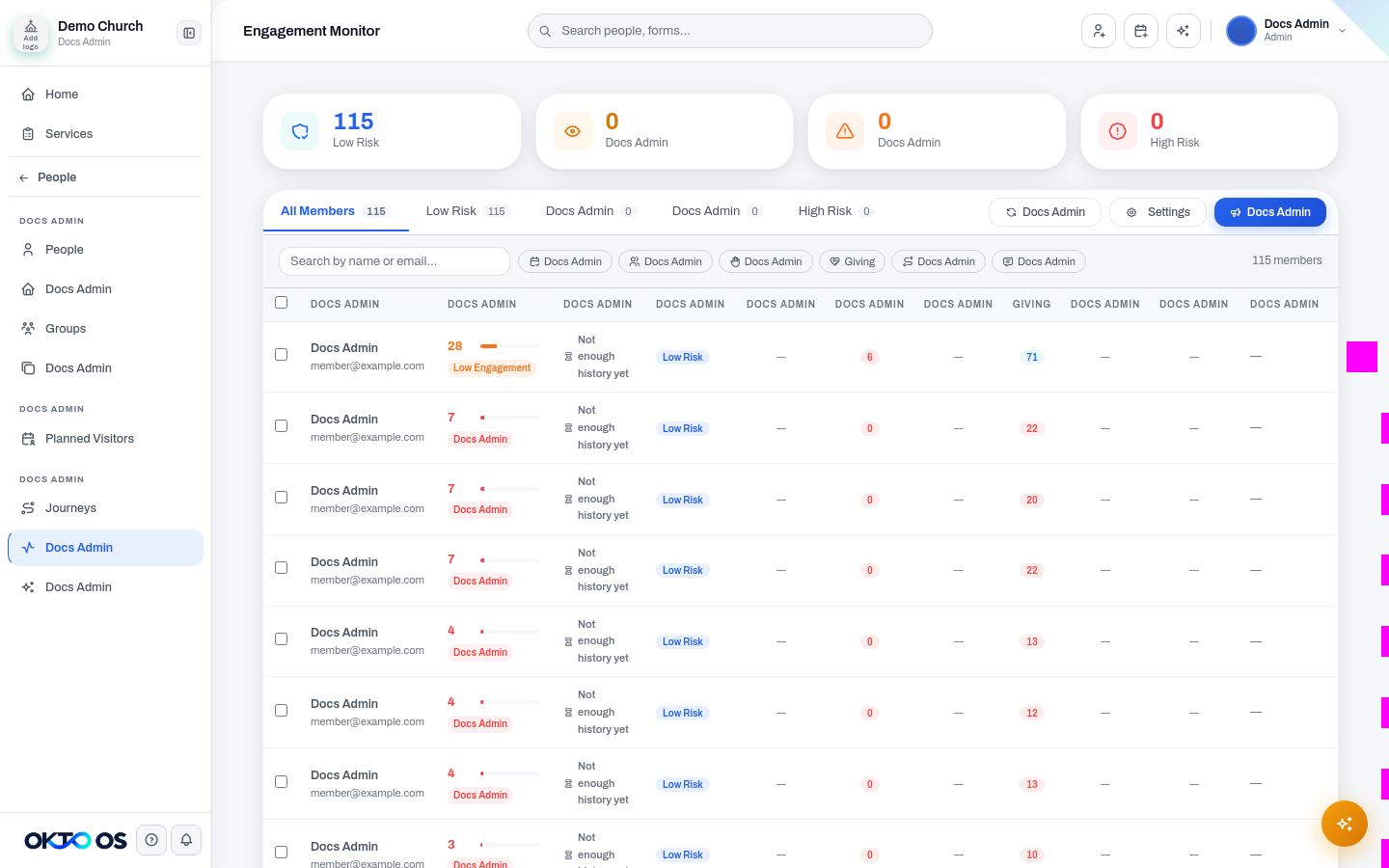
Section titled “Engagement”Engagement turns activity across OKTO into a practical pastoral signal. The goal is not to reduce people to a score; it is to help leaders notice meaningful changes early enough to respond with care.
Start with a goal
What do you want to do?
Choose the outcome that matches the work in front of you. You can come back to the deeper reference sections when you need details.
Understand the signals
Learn which person-level activities can contribute to engagement and which data should not be treated as individual attendance.
Read scores and risk
Use scores, tiers, and risk indicators as prompts for attention rather than final judgments.
Choose who should be scored
Keep the scoring population focused on active Member profiles so unrelated records do not distort the signal.
Follow up responsibly
Review the underlying history, protect sensitive context, and use engagement data to support—not automate—pastoral judgment.
Recommended flow
A good first workflow
- Confirm the person belongs in the engagement-scoring population.
- Review the score, tier, and recent change rather than reacting to one number.
- Open the underlying signals and recent history for context.
- Choose an appropriate human follow-up when the pattern warrants attention.
Who should be scored
Section titled “Who should be scored”The canonical scoring population is active profiles with a membership status of Member. Visitors, inactive profiles, former members, children, and other out-of-scope records should not be mixed into the member engagement population.
What counts as an engagement signal
Section titled “What counts as an engagement signal”Signals may come from activity such as:
- Giving activity and recency
- Group participation
- Serving or volunteer activity
- Form and next-step activity
- Communication engagement
- Individual attendance evidence when OKTO has a person-level signal
A sanctuary headcount by itself is not person-level attendance and should not be assigned to individual members. When individual attendance is not explicitly captured, OKTO can use other dated participation signals as evidence of connection without pretending the headcount identifies who was present.
Use the score as a prompt, not a verdict
Section titled “Use the score as a prompt, not a verdict”Scores and tiers should direct attention, not make pastoral decisions. Review the underlying signals and the person’s recent history before starting follow-up.